




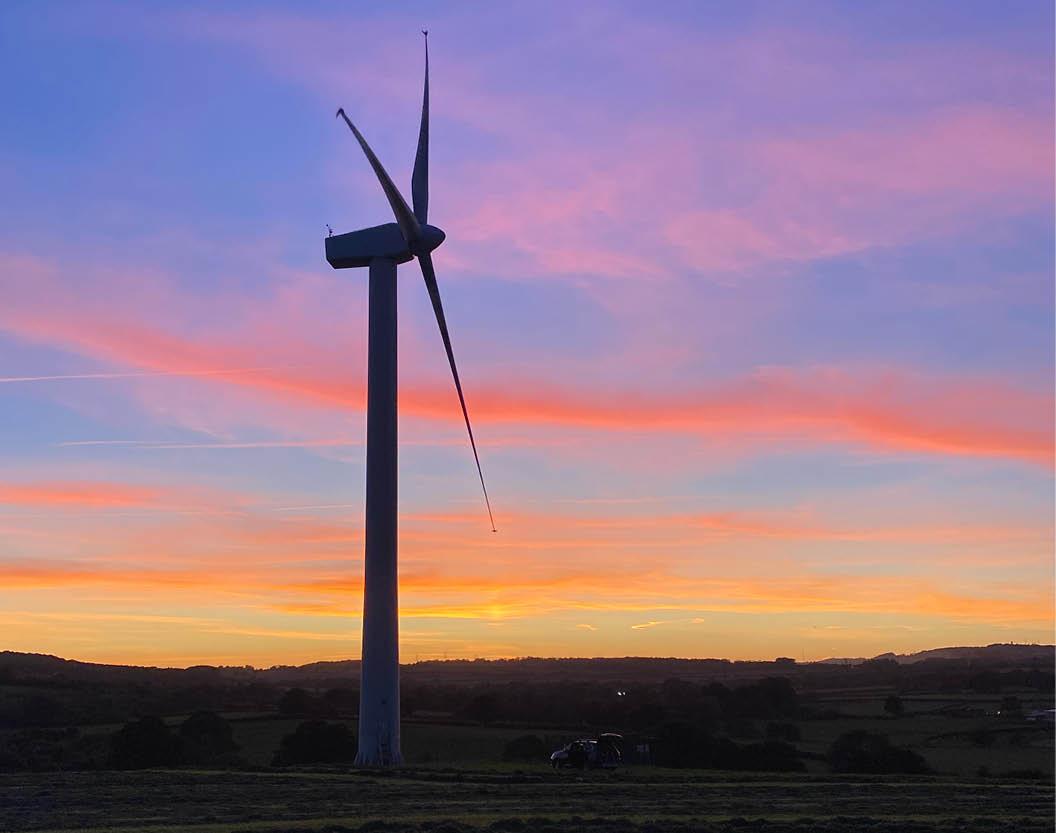
It's not often that the Wildcare team get to be hands-on with surveys, but when Paul Howden-Leach of Wildlife Acoustics approached us for some help with gathering data for their new SMART System, it was an opportunity that our thermal expert Jack couldn't pass up!
Wildlife Acoustics' SMART System uses real-time bat detection to reduce bat fatalities, curtailment costs and downtime on wind farms. For all their benefits as a source of sustainable energy, wind turbines pose a deadly threat to any bats passing by, which can easily be injured either by a direct hit from the blades, or from barometric pressure changes in the area. However, with SMART installed, once the system hears a bat, it is is able to turn off the turbines and then start them up again once the bat has moved on. You can find out more about SMART on the Wildlife Acoustics website here.
At their test site in the South West, Paul was attempting to gather footage of a bat passing and the turbine coming to a stop. However, wasn't getting very far with his night vision camera set up. The IR floodlighting just wasn't powerful enough to see a little bat at the height of a wind turbine. This is where we were able to step in and help using thermal imagers.
Unlike other night vision set-ups, thermal imagers are stand-alone units that negate the need for supplementary lighting. They can see for hundreds of metres by detecting heat radiation signatures, with hot features contrasting brightly against a colder background. In other words, perfect for spotting mammals, like bats, at a distance!
The site was an arable grassland with hedgerow boundaries, which included oak trees. In the area Paul and Jack spotted Common and Soprano Pipistrelles, Brown Long-Eared bats foraging at low levels around the site, as well as Noctules above the trees.
We used the HIKMICRO Falcon FQ25, HIKMICRO Condor CQ35, Pixfra A613 and HIKMICRO Lynx LH25 2.0 on site and the end, it was the HIKMICRO Falcon FQ25 that caught the perfect shot of a bat passing and the turbine coming to a stop. Take a look below! You can see the bat coming into frame form the left at 0.12 seconds, passing through the blades and the turbine slowly coming to a stop.
Are you interested in thermal cameras for your surveys next year? Take a look at our blog to help you choose a camera for your needs, or speak to Jack by email or call 01451 833181.